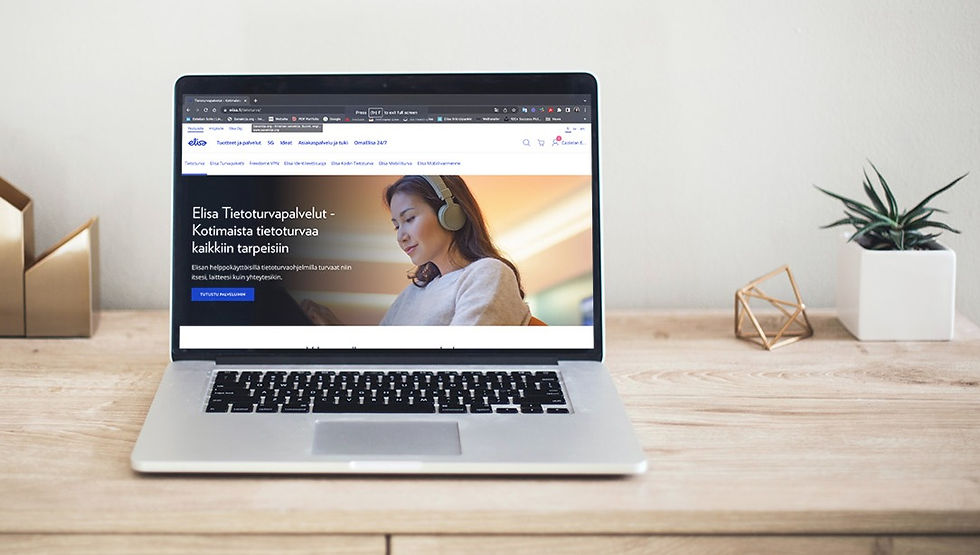
Making retail human again
Role: Service designer
Company: Elisa
Year: 2022
Big telecommunication corporations like Elisa have two main challenges: generate revenue through loyalty and offer the best experience to their customers. However sometimes the experience customers get from these companies feels shallow and money oriented rather than feeling that they care about them and their needs. Here is where my team helped to bring the human back into the ecuation.
In this project I was tasked to increase awareness of Elisa's digital security solutions and services related to them. The goal I set as I went on, was to stand out as an expert in digital security and to be able to guide customers towards the right solutions for them. The focus in the content is in the customer and their needs. Just how it should be.
My role in short:
Service designer & UX expertise
Research and facilitation
Ideation, concepting and validation
Validated and tested concepts for development
Collaboration enablement with business and SEO experts
Retail strategy development
Main digital touchpoint optimisation
Responsibilities:
1. Research on users
2. Collaboration with business and development
3. Data analysis
4. Workshop facilitation
5. Ideation and collaboration enablement
6. User personas, journey mapping and service development
7. Low and High-fidelity design and prototyping
8. Concept validation and user testing
Context
We all know how important is to feel safe while using our digital devices. In today's world there is a big number of digital threats that could affect our daily lives. Elisa offers different services of digital security and information regarding threats and healthy habits, however, users of the website and customers in the physical stores don't see it that way which reflects on the awareness and sales. Elisa is interested in its customers and their needs and I made my mission to understand the experience customers are having and how could we make it something centered in them awnd with the only purpose of act as a guide towards smart decision making and not as a sales person.
"How can our webpage family for digital trust empower customers to make the best purchase decision and make the best out of their purchased solutions? How can these pages help Elisa be perceived as an expert in the subject and a trustworthy service provider?"
Research
The first step for me was to truly understand the customer's current experience and their needs. Even though it was not a popular opinion, I managed to get research done and the findings were what truly shaped this project and its outcomes.Research was done in two settings: With customers at the physical stores and users of the main website, which I was responsible for the design.
The one key problem:
The research took a bit over three weeks where I was set on asking about the main experience of the users when looking at different products and considering hiring any of Elisa's additional services. I created a questionnaire that then replicated as a pop-up in the main website while I used it in the physical stores.
The main interesting thing that came up from the research was the number of answers. Both online and on-site, the response of customers was very positive. We had a lot of people accepting to answer the questions both online and at the stores and the very first comments indicated that they were surprised and happy to be asked about their opinions. This alone would set the direction in which the rest of the insights would follow. The first thing that we got was that customers really had no clue of what any of the additional services would bring to their lives. In fact, by their experiences we realised that the main problem was that there was no information, written or given that would change this. Their experiences, which were surprisingly similar, indicated that they are often faced with different promotions, descriptions of packages and bundles prices, but seldomly, with an actual explanation of what services are or reasons for them to buy them. In the worst cases, not only was there no information, but customers faced very aggressive sales behaviors where sales people would push too much to persuade them to buy services they actually don't need. On the website, this was manifested by many "Buy now" buttons that would appear in every section people would browse. This shed light to the most valuable insight from this research:
Customers don't consider that Elisa cares about them and their needs. They feel like they are just seen as more sales or income. When they meet an opportunity to be helped, all they find is a sales pitch and if they agree to buy, they often end up finding out that they did not need what was sold.
User Personas:
As mentioned before, the user research was carried out considering both physical and digital touchpoints. The major insight was revolving around customers and users feeling like means towards profit and not feeling taken care of or their needs. Based on the data and insights, I presented three personas described as follows:
Elsa, 21
She is in her early 20s and goes online often to check on promotions and benefits or when she needs information. She would go to the store only to pick up a product or when there is an issue.
Key Needs:
Relatable information | Engaging content | Examples over packages | Recommendations
Key challenges:
Understand her challenges and needs | Present products in a caring way | Keep the content engaging
Jari, 65
He prefers visiting the store than going online. He believes that the internet is full of difficult words and terms and he can get straight answers from people regarding his issues or needs.
Key needs:
Relatable and simple information | Simple interactions | Rich in information more than offers
Key challenge:
Use simple language | Maintain interactions simple | Make internet sales accessible enough
These personas were created based on the insights gathered during the research and shed light on the different needs and challenges for designing a better and more human-centric experience for the customers. As you can see above, the clear differentiator in terms of wether users go or not to the store or the webpage was mainly age, however, the needs align to some degree. For a younger persona, finding engaging and relatable content is crucial, however this is similar to what older customers look for in the store. Similarly, it was interesting to see how the need for simple information & interactions on the website for older users matches the need of the young customers for simple interactions at the store. The key challenges in this sense overlap but have clear differences when it comes to the audience.
The personas helped the business team understand better the need for a more human-centric approach to the whole retail experience for the digital security products and made it clear that the changes should be made in that direction. As most of the products were visible and could be purchased through the website, the decision of prioritising the digital touchpoint was made and so, by shaping it to a more human-centric one, the physical experience would follow.
Designing the new Tietoturva experience

The design of the digital experience was the result of many workshops and collaboration with the different stakeholders and key professionals that could support the experience. This included business, marketing, development and communications experts. By looking at the personas and the goals that the stakeholders had, we could define a common goal (Northern Star) to follow and define clear roles and responsibilities to make it happen, so as the ways we would be measuring success in the days to come.
What is and what isn't a great experience
A very important step for us was to define then the ideal experience for our personas. We focused on prioritising their needs and aligning them with the business goals. Therefore we defined the ideal experience as:
"When you visit the Tietoturva pages you find information about the different risks you might encounter when using your mobile connection. You can also find different alternatives in which Elisa can help you feel more safe and take good care of your information. The main goal of our pages is to guide our customers to empower them to make the decisions that suit their needs the best."
Additionally, we defined what does not constitute a great experience and that is:
-
Lots of "Buy now" buttons
-
Sales or technical jargon
-
Lack of real examples
-
Push to sell
-
Disable communication or feedback

After defining the right experience, we planned some sprints to develop "Tietoturva" as a family of pages in which all the products could belong to a same family in order to be able to make it look concise and give the users chance to explore them individually. The interactions within the page were kept as simple as possible and the content prioritised examples and real-life situations over content on prices and packages.
Finally, we enabled cross-selling between the Tietoturva family members in order to fulfill a business goal, however, the way our pages would show different products would match information on other problems or security risks first. In other words, the idea was not to present more products and try to sell them, but present more information on other key issues customers face regarding security for which Elisa might have a solution. In this way, the experience is less about browsing a catalogue of products and more of an information board that allowed the customers to get more knowledge and, hopefully, empower them with it to make a decision about Elisa's products.

Elisa's Tietoturva is a place where all your digital security needs are covered and all your questions answered in order to guide you to make the best decision provided by one of the top experts in the market.
Common visual language
All our digital trust pages share the same language and elements to make it easier for our customers to compare solutions and make a good purchase decision.
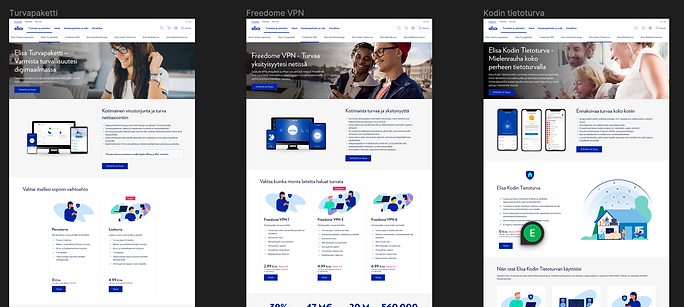

Identity beyond our pages
We made sure that the identity of the pages is maintained even outside of the main domain. This means that you can still identify our products in appstores and other digital spaces. Multiple products, one strong identity.
Available for all
Our pages are optimised for search engines and easy to find when you look for digital security online. When navigating them, you can also easily move along them without coming back to the main page. The experience is designed to be simple to understand and interact with and making sure anyone in Finland can feel sure they are talking with experts that care about their safety.

Remarks
The project began in 2022 and up to the year 2023, up to six pages regarding Tietoturva products were designed and deployed. We ran a new questionnaire after the release of the pages to measure the user's satisfaction and know their opinion about the new experience. The results were overwhelmingly positive and pointed to users of all ages noticing the changes and finding the help they needed and feeling seen as customers and not only sale targets. This new experience model was agreed to be used for other products than digital security ones. Additionally, the physical stores, got a customer playbook summarising the experience goals from the website but adapted to the stores. In my time in Elisa I didn't get to measure the effectiveness of the physical store experience. The products and services might have changed at the moment of reading this portfolio to match current campaigns and branding but the design principles remained as far as I can tell.